
Acceptance – The Bridge Between Vision and Reality
This is Part 3 of the CRAFT Framework series. Culture provides the foundation. Relationships provide the connections. Acceptance transforms those connections into commitment.
The Core Problem: Communication ≠ Acceptance
Organizations fail not because people do not understand the strategy. They fail because people do not accept it.
Leaders often confuse communication with acceptance, assuming that if people heard the message and did not object, they are committed.
But acceptance is not passive agreement — it is active commitment.
The traditional approach of Tell – Train – Launch creates compliance without commitment. People know what to do but have not accepted why it is worth the disruption.
The result is organizational fiction — plans that exist on paper but not in practice.
A Better Path: See – Ask – Support – Invite
SEE
Help people witness the need directly through exposure to reality.
ASK
Solicit perspectives before dictating solutions.
SUPPORT
Provide resources, remove barriers, and create safety for experimentation.
INVITE
Make participation a choice, not a mandate.
The Ladder of Acceptance: Ten Rungs from Resistance to Commitment
People move through distinct stages when experiencing change:
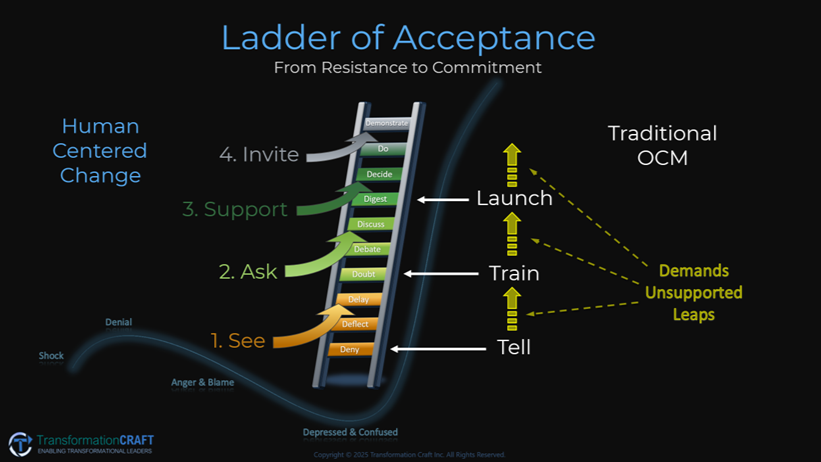
- DENY – “This is not really happening.”
- DEFLECT – “This is someone else’s problem.”
- DELAY – “We should wait and study this more.”
- DOUBT – “I do not think this will work.”
- DEBATE – Engaging with substance and questioning assumptions.
- DISCUSS – Exploring how it might work.
- DIGEST – Processing implications and personal impact.
- DECIDE – Committing internally to engage.
- DO – Taking initial action and experimenting.
- DEMONSTRATE – Becoming an advocate and pulling others forward.
The power is not in the labels, but in the practice of measuring where people are.
Effective leaders map their organization across these rungs to identify clusters of resistance and momentum, then meet people where they are rather than where they wish they were.
Progress is not linear. People can move up and down the ladder as circumstances change.
The key is celebrating movement — not just arrival.
If you are asking for acceptance but most of your organization is still at Doubt or Debate, launching harder will not help. The underlying concerns must be addressed before commitment can emerge.
The Professional vs. Corporate Goal Tension
Here is a conversation most leaders avoid:
Sometimes what is best for the organization is not what is best for the individual.
A company pivots to a new market and an employee’s expertise becomes less relevant.
A strategic shift requires relocation.
A reorganization eliminates a role someone loves.
When corporate and professional goals diverge, pretending otherwise breeds resentment — not acceptance.
Mature organizations create space for this tension by acknowledging it openly.
They tell people honestly that the direction may be right for the company but not right for everyone, and that misalignment should be navigated together rather than hidden.
This conversation requires courage from both sides, but it produces clarity:
- Some people self-select out, finding roles that better fit their goals.
- Some discover unexpected alignment once the real conversation begins.
- Some make conscious trade-offs, accepting short-term misalignment for long-term opportunity.
Everyone gains clarity — which is infinitely more valuable than false consensus.
Walking a Mile in the Trenches: Earning Credibility
Leaders who consistently earn acceptance do not ask for what they have not experienced themselves.
When Howard Schultz returned as CEO of Starbucks in 2008, he spent weeks working as a barista, experiencing the reality frontline employees faced every day. When he later asked for sweeping changes, people accepted them not because he had authority, but because he had credibility.
When Satya Nadella became CEO of Microsoft, he did not immediately announce a new strategy. Instead, he listened — sitting in customer meetings and visiting field offices. When he eventually called for a “growth mindset” culture, people knew he understood what he was asking them to change.
This is not performative. It is essential.
You cannot ask for acceptance of something you do not truly understand.
Too many executives operate from abstractions — spreadsheets and consultant reports. They know what needs to change intellectually but not experientially.
When they communicate change, it lands as theory, not reality — and people sense the gap immediately.
Leaders who earn acceptance:
- Experience frontline reality before asking others to accept changes to it.
- Spend time in customer service queues, on sales calls, and in operational environments.
- Acknowledge what they are asking without minimizing the difficulty.
- Stay visible and accessible during transitions.
- Share their own doubts and learning, modeling acceptance themselves.
Leadership Styles and Communication for Acceptance
Not all leadership styles generate acceptance equally.
Directive Leadership
Can be appropriate in crisis or when speed is essential. However, it rarely generates deep acceptance. It produces compliance, which may be sufficient in the short term but is brittle over time.
Collaborative Leadership
Invites co-creation and typically generates stronger acceptance. However, it is slower and requires leaders to genuinely be open to influence.
Coaching Leadership
Builds the deepest acceptance because it develops people’s own thinking. However, it can be inefficient when time is constrained.
The most effective leaders shift styles based on context and are explicit about why.
Communication That Generates Acceptance
When leaders communicate change, they typically optimize for clarity:
“Did people understand what I said?”
But acceptance requires a different question:
“Do people believe what I said is worth the cost?”
Communication that generates acceptance:
- Starts with why, grounded in reality rather than aspiration
- Invites dissent before demanding agreement
- Asks what concerns people most and what the leader might be missing
- Makes the choice explicit rather than assumed
- Acknowledges difficulty and creates space for honest responses
- Tracks acceptance, not just compliance — measuring where people are on the Ladder rather than assuming launch equals adoption
The Connection to Relationships
Strong relationships are the fabric that holds organizations together.
Acceptance is what that fabric enables.
Without relationships — without trust, respect, and genuine connection — acceptance is impossible.
People do not accept change from leaders they do not trust. They do not commit to strategies they believe were created without understanding their reality.
But relationships alone are not sufficient.
A leader can have strong relationships and still fail to earn acceptance if they do not:
- Help people see why change is necessary
- Create space for honest tension between personal and corporate goals
- Communicate in ways people can understand
- Demonstrate they understand what they are asking
- Meet people where they are on the Ladder
Acceptance transforms relationships from pleasant connections into operational leverage.
It is where the relational capital leaders build is spent — and when invested wisely, it generates returns in the form of commitment, momentum, and collective will.
The Acceptance Imperative
The choice is simple:
Do you want compliance, or do you want commitment?
Only one builds organizations that last.
Leaders who succeed create conditions where acceptance becomes possible.
They meet people where they are on the Ladder, not where they wish they were.
They acknowledge the tension between professional and corporate goals rather than pretending it does not exist.
They experience the reality they are asking others to accept.
They shift their leadership style and communication approach to invite genuine commitment — not just compliance.
This approach is harder than Tell – Train – Launch.
It is slower.
It requires vulnerability.
It requires patience.
But it is the only path to genuine acceptance.
Because without acceptance, everything else is just noise.
At the end of the day, even the best strategy in the world is worthless if the people responsible for executing it have not accepted that it is worth doing.
Communication ≠ Acceptance.
Do you want compliance, or commitment?
Next in the Series
Focus – Why what you stop doing matters more than what you start.