
Culture
The Foundation That Makes Everything Else Possible
Culture is often treated as a soft concept — something to be shaped after strategy is defined and execution is underway.
That assumption quietly undermines more transformations than any technology decision ever could.
Culture is not what an organization says it values.
It is how decisions are made when tradeoffs are unavoidable.
When leaders ignore culture, they don’t get a neutral outcome. They get friction, resistance, and inconsistent execution — even when the strategy itself is sound.
Culture Is the Operating System of the Organization
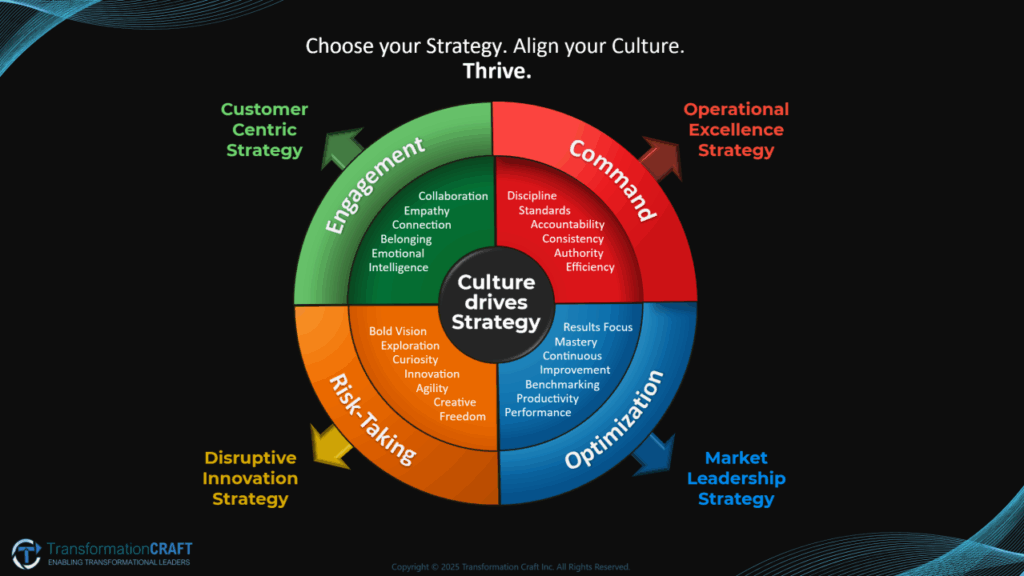
Every organization has a culture.
Not the one described in decks, town halls, or leadership principles — but the one that actually governs behavior:
- How risk is treated
- How conflict is handled
- How decisions are escalated or avoided
- How accountability is enforced (or quietly bypassed)
This lived culture becomes the organization’s operating system.
It determines how work gets done, regardless of how clearly strategy is articulated.
Strategy defines where you want to go.
Culture determines whether the organization is capable of getting there.
The Hidden Failure Mode: Culture Clash
One of the most common — and least named — reasons transformations stall is culture clash.
Culture clash occurs when leaders attempt to operate with multiple, competing cultural orientations at the same time.
For example:
- Asking teams to move fast, while rewarding risk avoidance
- Promoting collaboration, while reinforcing individual heroics
- Calling for innovation, while punishing failure
In these environments, people don’t resist change because they are unwilling.
They resist because the system is incoherent.
When culture sends mixed signals, people default to what feels safest — not what leaders say they want.
Choosing a Dominant Cultural Orientation
Effective transformations require leaders to make an explicit choice.
Not about values in the abstract — but about which cultural orientation will dominate when tradeoffs arise.
Every organization exhibits multiple cultural traits. The problem is not diversity of style.
The problem is ambiguity about which behaviors win when priorities collide.
Strong cultures are not broad.
They are clear.
Leaders who succeed in transformation are willing to:
- Name the dominant cultural orientation required to support the strategy
- Reinforce it consistently through decisions, not slogans
- Accept the discomfort that comes with saying “no” to misaligned behaviors
This clarity creates psychological safety — not because everything is allowed, but because expectations are unambiguous.
Culture Is Reinforced Through Decisions, Not Messaging
Organizations do not learn culture through communication.
They learn it through observation.
People watch:
- What gets approved quickly
- What gets delayed or questioned
- What behaviors are rewarded, tolerated, or quietly ignored
Over time, these signals teach the organization how to survive.
When leaders say one thing and decide another, the decision always wins.
That is why culture work cannot be delegated or deferred.
It lives squarely in the choices leaders make when pressure is highest.
Diagnosing Culture Before You Transform
Before launching or accelerating a transformation, leaders should ask:
- What behaviors are currently required to succeed here?
- Where do stated values and lived decisions diverge?
- Which cultural traits are being rewarded — intentionally or not?
- What behaviors would need to change for this strategy to work?
Without honest answers to these questions, transformation efforts rest on hope rather than capability.
Culture as the First Element of CRAFT
CRAFT begins with culture because every other element depends on it.
Relationships cannot flourish in a culture that rewards avoidance.
Acceptance cannot emerge in a culture that punishes dissent.
Focus cannot exist in a culture that treats everything as urgent.
Trajectory cannot be trusted in a culture that measures the wrong things.
Culture is the foundation — whether leaders choose to shape it or not.
Next:
Explore the second element of CRAFT — Relationships: the infrastructure through which all strategies must flow.