
Introduction to the CRAFT Framework
Why Most Transformations Fail
Most organizational transformations fail.
Not because of lack of investment.
Not because of poor strategy.
Not because of insufficient technology.
They fail because leaders skip the fundamentals.
Over the past year, we have collaborated with transformation specialists, consultants, and strategists who have seen the same pattern repeat itself. Organizations invest millions in strategy, technology, and change management — only to watch their transformations stall or collapse.
The failure point is consistent.
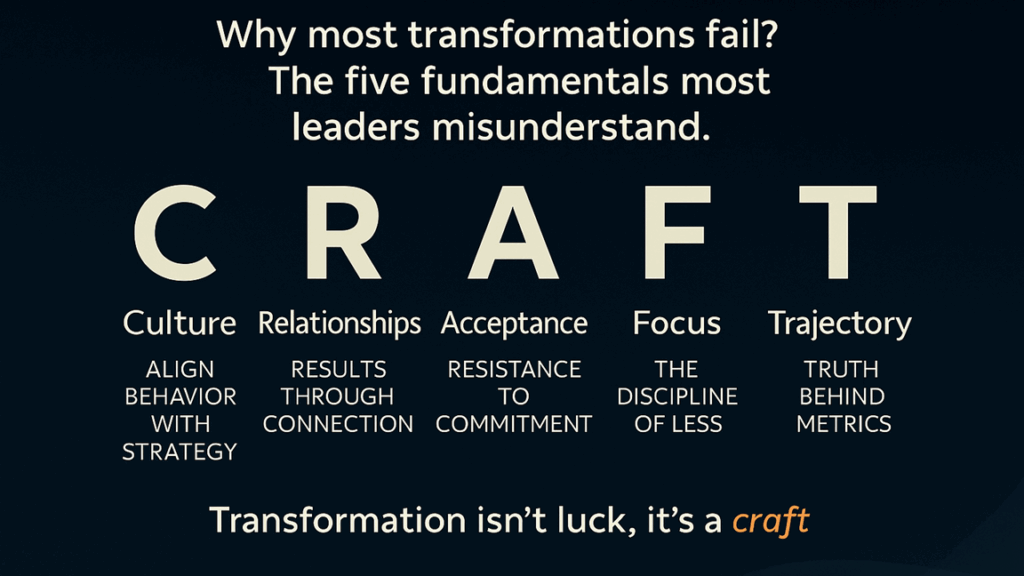
Leaders underestimate five foundational elements that quietly determine whether transformation efforts succeed or fail:
Culture — the invisible operating system that determines how work actually gets done.
Relationships — the infrastructure through which all strategies must flow.
Acceptance — the psychological bridge from resistance to genuine commitment.
Focus — the discipline of doing less to achieve more.
Trajectory — the metrics that reveal whether you are moving toward or away from your goals.
Together, these five elements form the CRAFT Framework.
Why CRAFT Is Different
Most transformation frameworks start with vision and strategy, assuming culture and relationships will naturally follow.
They do not.
CRAFT reverses this logic.
It begins by aligning culture to strategic intent — because while strategy defines where you are going, culture determines whether you can actually get there. Only once the human and organizational foundations are aligned does CRAFT build toward clarity, execution, and measurement.
This framework is not theoretical.
Each element emerged from patterns observed in failing transformations — and from the rare transformations that succeeded. CRAFT reflects what leaders consistently get wrong, and what effective leaders do differently when the stakes are high.
The Five Elements of CRAFT
The CRAFT Framework addresses five interconnected failure points that must be navigated together:
Culture
Why leaders must choose one dominant orientation — and why trying to be everything to everyone creates culture clash.
Relationships
Why even brilliant strategies fail when executed through broken or misaligned relationships.
Acceptance
Why communication does not equal commitment — and how leaders move people from resistance to genuine drive.
Focus
Why what leaders stop doing matters more than what they start.
Trajectory
Why people do what is measured, not what is preached — and how metrics quietly shape behavior.
Each element is explored through:
- The core problem most leaders miss
- A practical methodology for addressing it
- Real examples and diagnostic questions
- Clear, actionable next steps
Who This Framework Is For
The CRAFT Framework is designed for leaders who:
- Have launched transformations that stalled or lost momentum
- Suspect their culture is working against their strategy
- Wonder why teams are less committed than they claim to be
- Feel overwhelmed by too much work with too little impact
- Know their metrics are driving the wrong behaviors
If you have ever said, “We have a great strategy — we just need to execute better,” this framework is for you.
Execution is not a separate problem from strategy.
It is a CRAFT problem.
Next:
Explore the first element of CRAFT — Culture: the foundation that makes everything else possible.