
This article concludes the CRAFT Framework series.
Each element of the CRAFT framework has resonated deeply with me. Working alongside exceptional strategists and forward-thinking experts, it has fundamentally transformed my strategic consulting approach.
I now help organizations understand a powerful truth:
Saying “no” to the wrong things is what enables them to say “yes” to what truly matters.
The CRAFT Diagnostic: Five Questions
Use these questions to diagnose where your transformation efforts may be breaking down.
1. Culture
“What is our actual CORE — not what we say, but what we reward and tolerate?”
If you are not sure, or if different leaders give different answers, you likely have Culture Clash.
2. Relationships
“Can I name three people in other departments who would call me with bad news before it becomes a crisis?”
If you cannot — or if information flows upward but not across — you likely have relationship debt.
3. Acceptance
“Where are most people on the Ladder of Acceptance for our current transformation?”
If initiatives are launching while people are still at Doubt or Debate, the organization is generating compliance, not commitment.
4. Focus
“What would we stop doing if we were serious about our top three priorities?”
If nothing can be identified to stop — or if there are more than three “top” priorities — the organization lacks focus.
5. Trajectory
“If a frontline employee perfectly optimized their metrics, would the organization win or lose?”
If the answer is lose or I’m not sure, the organization’s metrics are driving it off course.
Where to Start: The CRAFT Sequence
Many leaders want to begin with Focus (fixing the portfolio) or Trajectory (fixing the metrics).
Resist that instinct.
The CRAFT sequence matters because each element enables the next.
Start With Culture
If your culture is misaligned, everything else becomes exponentially harder.
Action:
Identify your actual CORE (not your aspirational one). Then decide: is this the CORE you need?
If not, determine what must change.
Then Build Relationships
Once the CORE is clear, strengthen the relationships required to operate within it.
Action:
Map your key relationships across four layers:
- Internal
- Customer
- Stakeholder
- Partner
Where is trust strongest?
Where is it weakest?
Invest deliberately in closing those gaps.
Then Create Acceptance
With aligned culture and strong relationships, organizations can move people from resistance to commitment.
Action:
Map where people are on the Ladder of Acceptance.
Stop trying to launch initiatives while people remain at Doubt.
Meet people where they are and help them move upward.
Communicate in ways people can truly understand.
Then Apply Focus
Once commitment exists, direct that commitment toward what matters most.
Action:
Run every initiative through the three brutal questions:
- What will you stop?
- Who will you disappoint?
- What matters most?
Make the choice — and own it.
Finally, Align Trajectory
With focus established, ensure your metrics reinforce the priorities you have chosen.
Action:
Audit your dashboards.
Do they measure outcomes or activity?
Are they aligned vertically across leadership and horizontally across teams?
Fix the misalignments.
Common Mistakes
Mistake #1: Starting with Trajectory
Fixing metrics before fixing culture simply means measuring the wrong things more efficiently.
Mistake #2: Skipping Acceptance
Leaders often assume that because no one objected in the meeting, people are committed.
They are not.
They are compliant.
Mistake #3: Refusing to Choose (Culture)
Trying to be everything to everyone creates Culture Clash.
Choose your CORE — and accept the trade-offs.
Mistake #4: Adding Before Subtracting (Focus)
Saying yes to new priorities without stopping existing ones creates portfolio bloat.
Mistake #5: Measuring Everything
More metrics do not produce better decisions.
Ruthless selectivity matters.
Final Thought
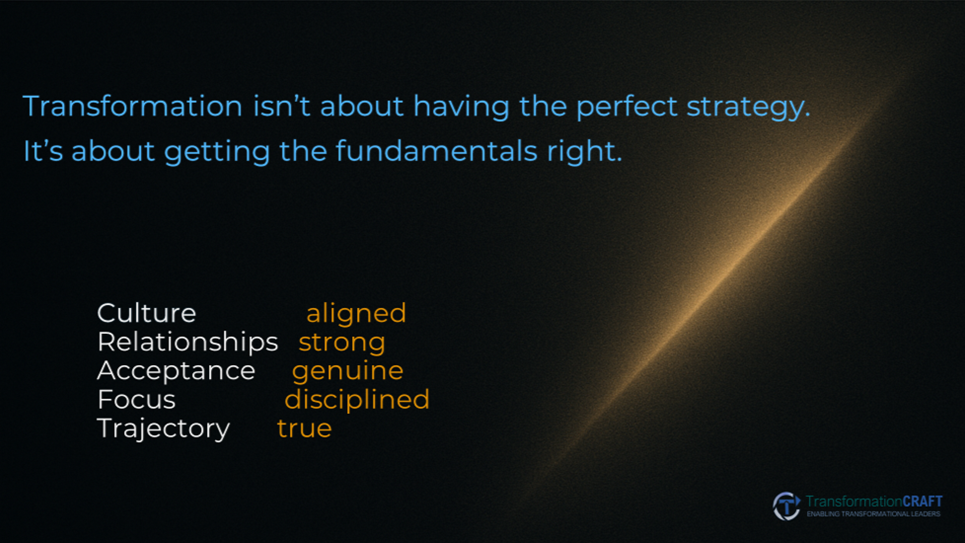
Transformation is not about having the perfect strategy.
It is about getting the fundamentals right:
- Culture that is aligned
- Relationships that are strong
- Acceptance that is genuine
- Focus that is disciplined
- Trajectory that is true
When these elements are in place, strategy becomes executable.
Ignore them, and even brilliant strategies fail.
The choice is yours.